Blackwell Industrial Intelligence is a specialised publication focused on the engineering systems, materials science, and manufacturing technologies that underpin modern industrial performance. We cover the full lifecycle of industrial innovation from advanced material development and aerodynamic product design through to CAD-driven engineering, CNC manufacturing, robotics, and global supply chain systems.
Our purpose is to translate complex industrial engineering domains into clear, structured intelligence for professionals, decision-makers, and technology stakeholders working at the intersection of design, production, and industrial automation. Unlike general technology publications, we focus exclusively on applied engineering systems and the infrastructure of physical-world innovation.
Modern industry is no longer defined solely by machinery or isolated production processes. It is defined by interconnected systems: computational design tools, high-performance materials, automated production environments, and data-driven supply chains. Blackwell Industrial Intelligence exists to analyse these systems in depth and explain how they interact to shape industrial competitiveness.
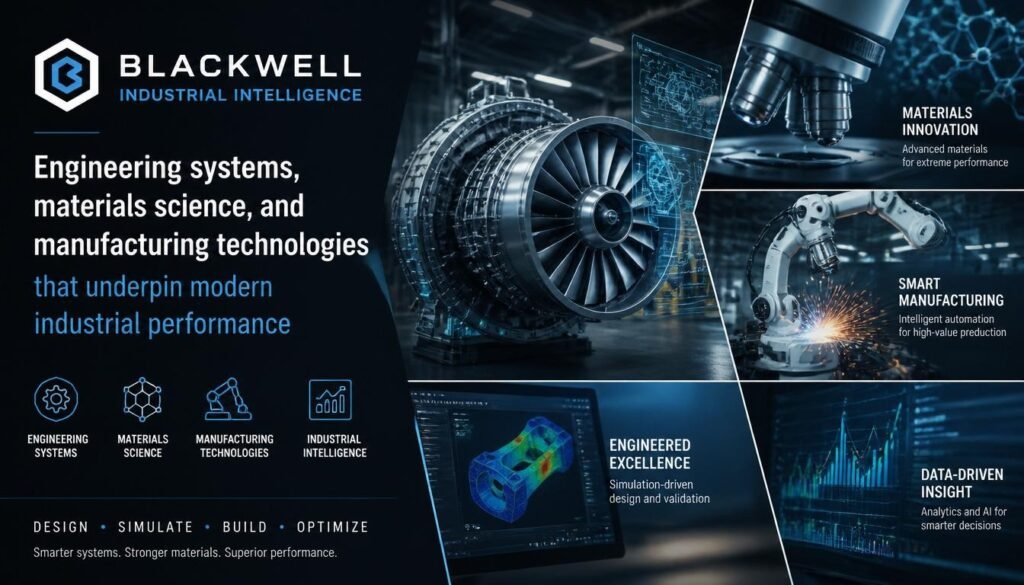
A Focus on Industrial Engineering Intelligence
Industrial innovation today is driven by convergence. Materials science informs design. Design informs manufacturing. Manufacturing informs logistics. Each stage is dependent on digital systems that optimise performance, reduce waste, and increase precision.
Blackwell Industrial Intelligence examines this convergence across six core domains. These pillars define our editorial structure and ensure deep, consistent coverage of the technologies shaping modern industrial capability.
We do not publish generalist technology commentary. We focus on applied systems, engineering workflows, and production technologies used in real industrial environments. Our content is designed for engineers, technical specialists, product designers, manufacturing operators, and technology vendors operating in high-value B2B sectors.
Blackwell Industrial Intelligence aligns its perspective with globally recognised industrial and engineering standards, including frameworks developed by the International Organization for Standardization (ISO). These standards underpin modern manufacturing systems, materials engineering practices, quality assurance protocols, and industrial automation processes used across global production environments.
Advanced Materials & Composites
Advanced materials sit at the foundation of industrial innovation. Carbon fibre composites, titanium alloys, engineered polymers, and next-generation resins are transforming how products are designed and manufactured.
We explore how materials behave under stress, temperature variation, and aerodynamic load, and how these properties influence real-world performance in aerospace, automotive, cycling, and industrial applications.
Key areas of coverage include composite fabrication techniques, fibre alignment processes, resin systems, thermal resistance engineering, and the industrialisation of advanced material production. We also analyse how additive manufacturing is enabling new classes of material structures previously impossible with traditional manufacturing methods.
This pillar connects directly to the evolution of high-performance engineering systems. From structural optimisation in aerospace components to lightweight industrial frameworks, advanced materials define what is physically possible in modern product design.
Product Design & Aerodynamics
Product design in industrial environments is no longer purely aesthetic or mechanical. It is a computational discipline governed by physics simulation, fluid dynamics, and performance optimisation.
This pillar focuses on aerodynamic engineering, wind resistance modelling, generative design systems, and simulation-driven product development. We analyse how engineers use computational fluid dynamics (CFD) tools to reduce drag, optimise airflow, and improve efficiency across mechanical systems.
We also examine how aerodynamic principles influence product design across industries, including transportation, sporting equipment, industrial machinery, and consumer hardware. Wind tunnel validation, virtual prototyping, and simulation-led design workflows are core areas of focus.
The evolution of design tools has shifted engineering from physical iteration to digital modelling. This transformation is central to modern industrial competitiveness, enabling faster development cycles and more precise performance outcomes.
CAD & Product Lifecycle Management (PLM)
Computer-Aided Design (CAD) and Product Lifecycle Management (PLM) systems form the digital backbone of industrial engineering. These platforms govern how products are conceptualised, designed, tested, manufactured, and maintained throughout their lifecycle.
We cover enterprise CAD ecosystems, including parametric modelling, assembly simulation, and integrated engineering workflows. We also examine PLM systems that manage version control, supply chain integration, compliance documentation, and production coordination across global teams.
Modern industrial organisations rely on CAD and PLM integration to maintain design integrity across distributed engineering environments. Digital twin technology is also becoming central, allowing real-time simulation of physical systems based on live operational data.
This pillar focuses on how software infrastructure enables industrial scale. Without CAD and PLM systems, modern manufacturing complexity would be unmanageable at scale.
Manufacturing Software & CNC Technology
Manufacturing is increasingly defined by software-driven precision. CNC machining, CAM systems, and shop-floor automation technologies have transformed traditional production into a highly digitised process.
We analyse how manufacturing software controls precision machining, toolpath optimisation, tolerances, and production efficiency. CAM systems are now central to translating CAD designs into physical components with extreme accuracy.
CNC technology has evolved into a data-driven manufacturing system where sensors, machine learning models, and real-time analytics optimise production quality. We also explore how manufacturers use MES (Manufacturing Execution Systems) to coordinate production workflows and improve operational visibility.
This pillar bridges the gap between digital design and physical production. It focuses on how software defines the accuracy, scalability, and efficiency of industrial manufacturing processes.
Robotics & Industrial Automation
Industrial automation represents the shift from manual production systems to autonomous, data-driven manufacturing environments. Robotics, machine vision, and AI-driven control systems are redefining factory operations.
We examine robotic assembly systems, automated inspection technologies, and intelligent production lines that operate with minimal human intervention. These systems rely on precision sensors, adaptive algorithms, and integrated control software to maintain operational consistency.
Industrial robotics is also expanding into logistics, warehousing, and quality assurance. Automated guided vehicles, robotic sorting systems, and AI-powered inspection platforms are increasingly standard in high-efficiency manufacturing environments.
This pillar focuses on how automation enhances productivity, reduces operational error, and enables scalable manufacturing systems capable of handling complex industrial workloads.
Supply Chain & Logistics Technology
Modern industrial systems depend on global supply chain networks that require precision coordination, predictive analytics, and real-time data integration.
We analyse supply chain software systems, logistics optimisation platforms, inventory management tools, and distribution technologies that support industrial production at scale. These systems enable just-in-time manufacturing, demand forecasting, and global resource allocation.
Supply chain intelligence is increasingly data-driven, incorporating predictive modelling, risk analysis, and automated decision-making systems. Industrial resilience now depends on the ability to anticipate disruption and dynamically adapt logistics strategies.
This pillar connects production to global distribution, ensuring that industrial output is efficiently delivered from manufacturing systems to end markets.
Industrial Intelligence for Modern Engineering Systems
Blackwell Industrial Intelligence is built on the principle that modern industry is a connected system of technologies rather than isolated disciplines. Materials influence design. Design influences manufacturing. Manufacturing influences logistics. And software governs all three.
We provide structured insight into these interconnected systems, helping professionals understand not just individual technologies, but how they operate together within industrial ecosystems.
Our coverage is designed for those working in or alongside industrial engineering environments, including:
- Mechanical and manufacturing engineers
- Product designers and industrial designers
- CAD and PLM specialists
- Robotics and automation engineers
- Supply chain and logistics professionals
- Technology vendors and industrial software providers
The Future of Industrial Technology
Industrial technology is entering a phase defined by convergence between physical systems and digital intelligence. AI-assisted design, autonomous manufacturing, digital twins, and advanced material engineering are reshaping how industrial products are conceived and produced.
Future competitiveness will depend on how effectively organisations integrate these systems into cohesive production environments. Blackwell Industrial Intelligence tracks these developments with a focus on real-world application rather than theoretical innovation.
We examine how emerging technologies transition from research environments into production systems, and how industrial organisations adapt to maintain operational efficiency and technological advantage.
A Platform for Industrial Knowledge and Innovation
Blackwell Industrial Intelligence exists to provide clarity in a complex industrial landscape. As engineering systems become more advanced and interconnected, the need for structured, high-quality analysis becomes increasingly important.
We focus on depth, accuracy, and industrial relevance. Our objective is to become a trusted reference point for industrial engineering intelligence, supporting both practitioners and technology providers operating within this ecosystem.
Industrial innovation is no longer linear. It is systemic, data-driven, and highly interconnected. Blackwell Industrial Intelligence provides the framework to understand it.
We respect your privacy and are committed to protecting your data; you can view our Privacy Policy for full details on how information is collected and used.